News
- Mar, 2025: Paper accepted and under publication process in Computers & Graphics.
- Jun, 2025: Website launched.
Abstract
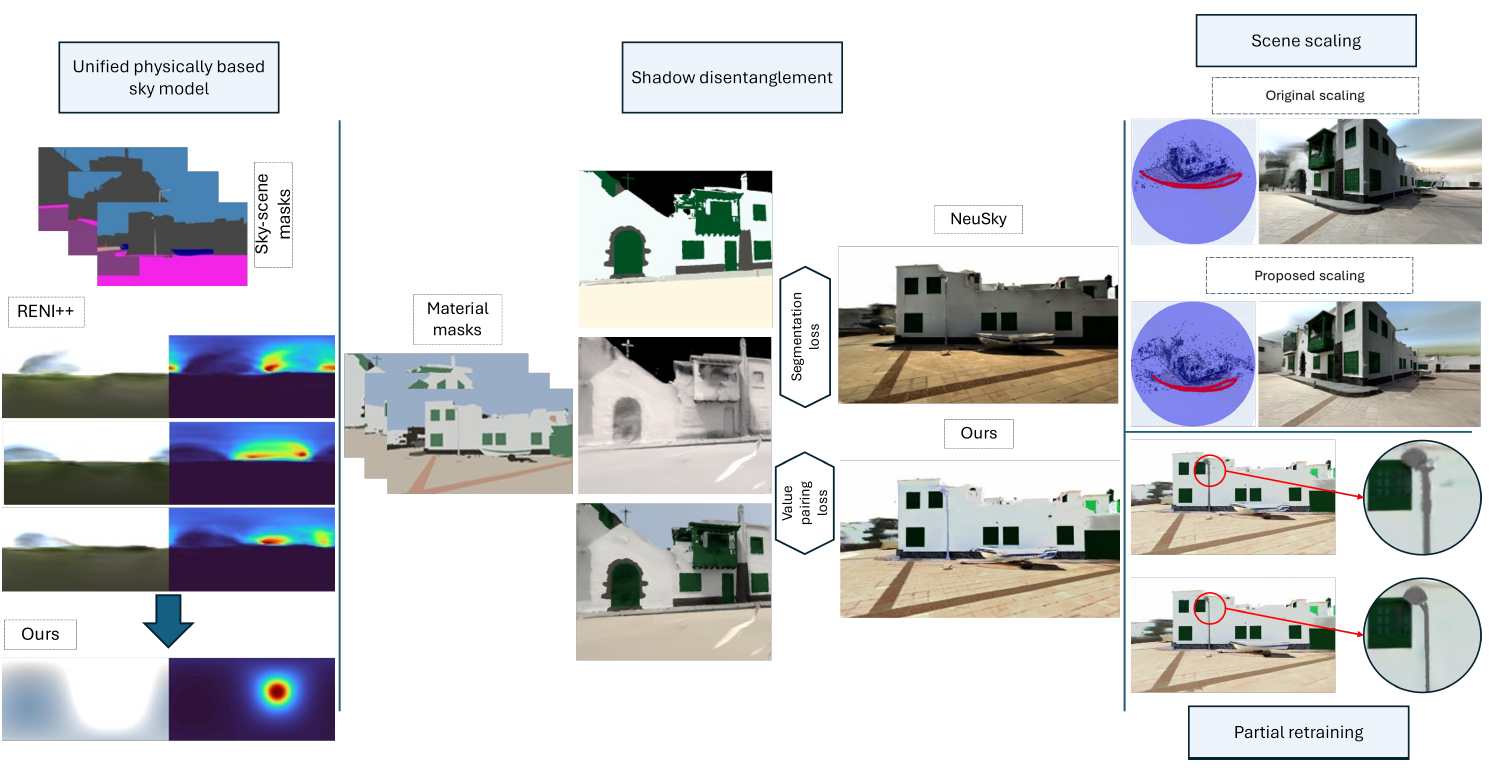
We present a novel approach that combines intrinsic decomposition of outdoor scenes with real-time rendering of new views under unknown illumination. Building on top of the state of the art, our method tackles the challenges of limited information in single-illumination scenarios by introducing pixel-level regularization terms aligning inferred material segmentation labels with albedo consistency estimators. For outdoor illumination, we adopt a physically-based sky model which increases the intrinsic decomposition robustness by relying on a reduced set of expressive parameters. Our approach enables partial retraining of 2DGS/3DGS models to render de-illuminated scenes in real time, with seamless integration into rendering engines for enhanced scene lighting, achieving better decomposition results than the state of the art.
Resources
Results
Overview Video
Explanatory video of Neuralux, showcasing motivation and main results.
Comparison with Prior SOTA
Viewpoint 1 – NeuSky (Prior SOTA) |
Viewpoint 1 – Neuralux w/o Partial Retraining |
Viewpoint 1 – Neuralux w/ Partial Retraining |
Viewpoint 2 – NeuSky (Prior SOTA) |
Viewpoint 2 – Neuralux w/o Partial Retraining |
Viewpoint 2 – Neuralux w/ Partial Retraining |
Bibtex
@article{alfonso2025neuralux,
  title={Neuralux: Improving the decomposition of single-illumination multiview outdoor scenes},
  author={Alfonso-Arsuaga, Mario and Castiella-Aguirrezabala, Andrea and Garcia-Gonzalez, Jorge and Bonilla, Jesus and Moreno, Jorge Lopez},
  journal={Computers \& Graphics},
  pages={104279},
  year={2025},
  publisher={Elsevier}
}